 Ahmed Alaydi
Hotel Booking Platform – UI/UX & Responsive Refactor
A large-scale hotel booking platform where I redesigned the UI, fixed responsiveness issues, and improved the overall user experience across all devices.
- Role
- Lead Engineer
- Timeline
- Production
- Industry
- Backend Systems
- Status
- Shipped
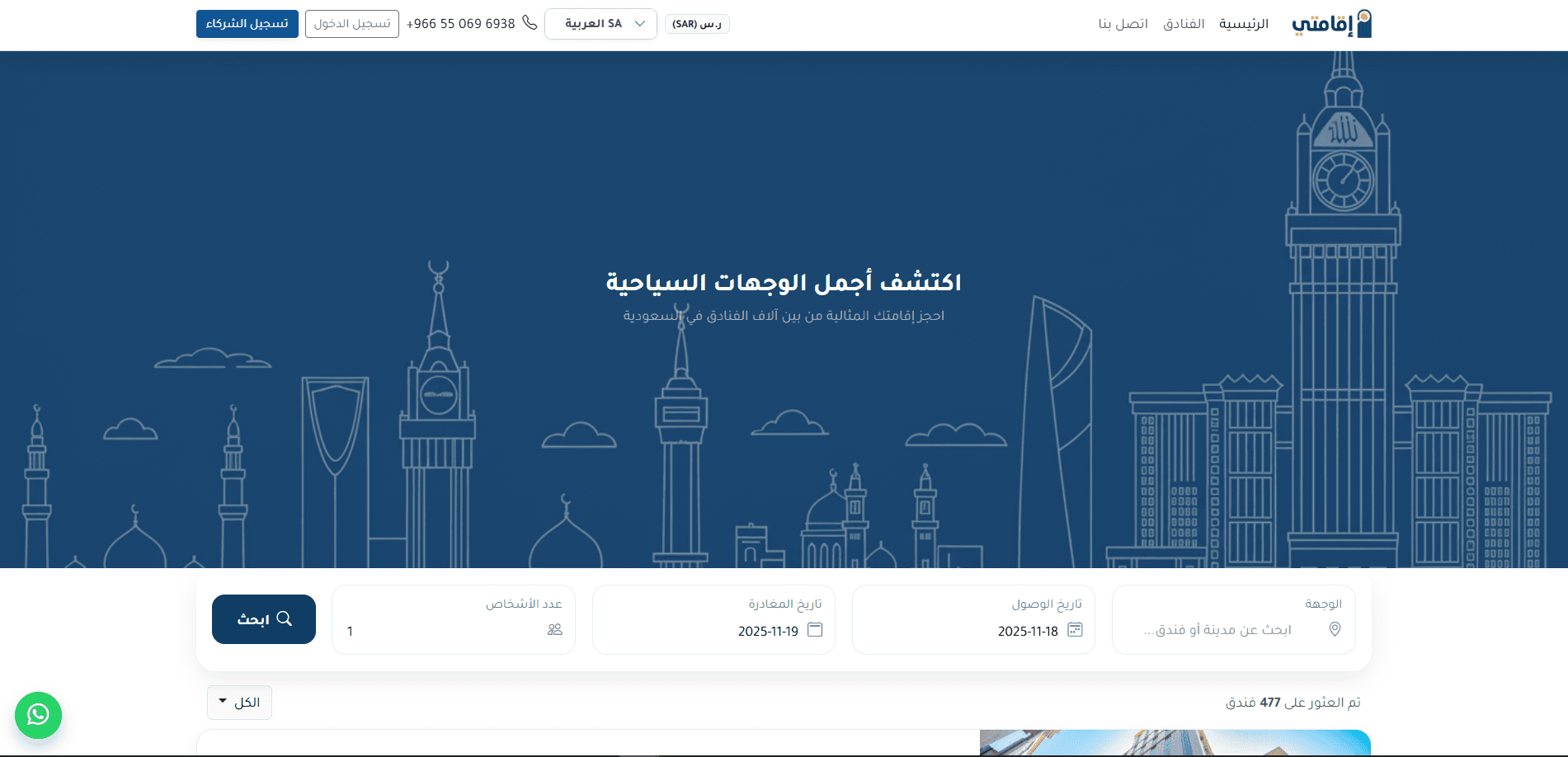
What this system is
This project involved working on an existing hotel booking platform built with Laravel Blade. The system had usability and responsiveness issues, especially on mobile and tablet devices. I fully restructured the frontend layout, improved the visual hierarchy, fixed broken responsive behavior, and enhanced the user flow across search, listing, and hotel details pages. The goal was to make the platform production-ready and user-friendly without changing the core backend logic.
What we needed to solve
The platform was not fully responsive and suffered from inconsistent layouts, poor mobile experience, and difficult navigation, which negatively impacted user engagement and booking flow.
How we shipped it
I refactored the frontend structure, redesigned key pages, fixed responsive breakpoints, and improved UI consistency while keeping the existing Laravel Blade architecture intact. This resulted in a smoother booking experience across desktop, tablet, and mobile devices.
How the system is wired
A modular architecture separating presentation, application, and data layers with REST contracts between the frontend and backend. Designed for clean scaling, observability, and predictable deployments.
Server-rendered + responsive client UI with reusable components and animation primitives.
Business logic in service classes, validated input, role-aware authorisation, and queueable side-effects.
Relational schema with indexed lookups, soft deletes, and migration-backed evolution.
REST APIs, webhooks, and third-party SDKs surfaced through thin adapters.
Engineering choices
In the wild
Hard problems, handled
The platform was not fully responsive and suffered from inconsistent layouts, poor mobile experience, and difficult navigation, which negatively impacted user engagement and booking flow.
I refactored the frontend structure, redesigned key pages, fixed responsive breakpoints, and improved UI consistency while keeping the existing Laravel Blade architecture intact. This resulted in a smoother booking experience across desktop, tablet, and mobile devices.
Maintaining performance under realistic production load.
Indexed queries, paginated lists, image optimisation, and lean client bundles kept the platform responsive end-to-end.
Built to stay fast
Design and interaction
Ready to ship and operate
What it does
Why we chose what we chose
Built on Laravel, Blade Templates, HTML.
Mature ecosystem, strong typing where applicable, and predictable performance characteristics for the workload.
REST-first integration boundary.
Keeps clients (web, mobile, partner) decoupled and trivially swappable without coupling to a single transport.
Results
Other case studies
Building something similar?
Let's scope your platform — dashboard, mobile apps, APIs, the full stack.