
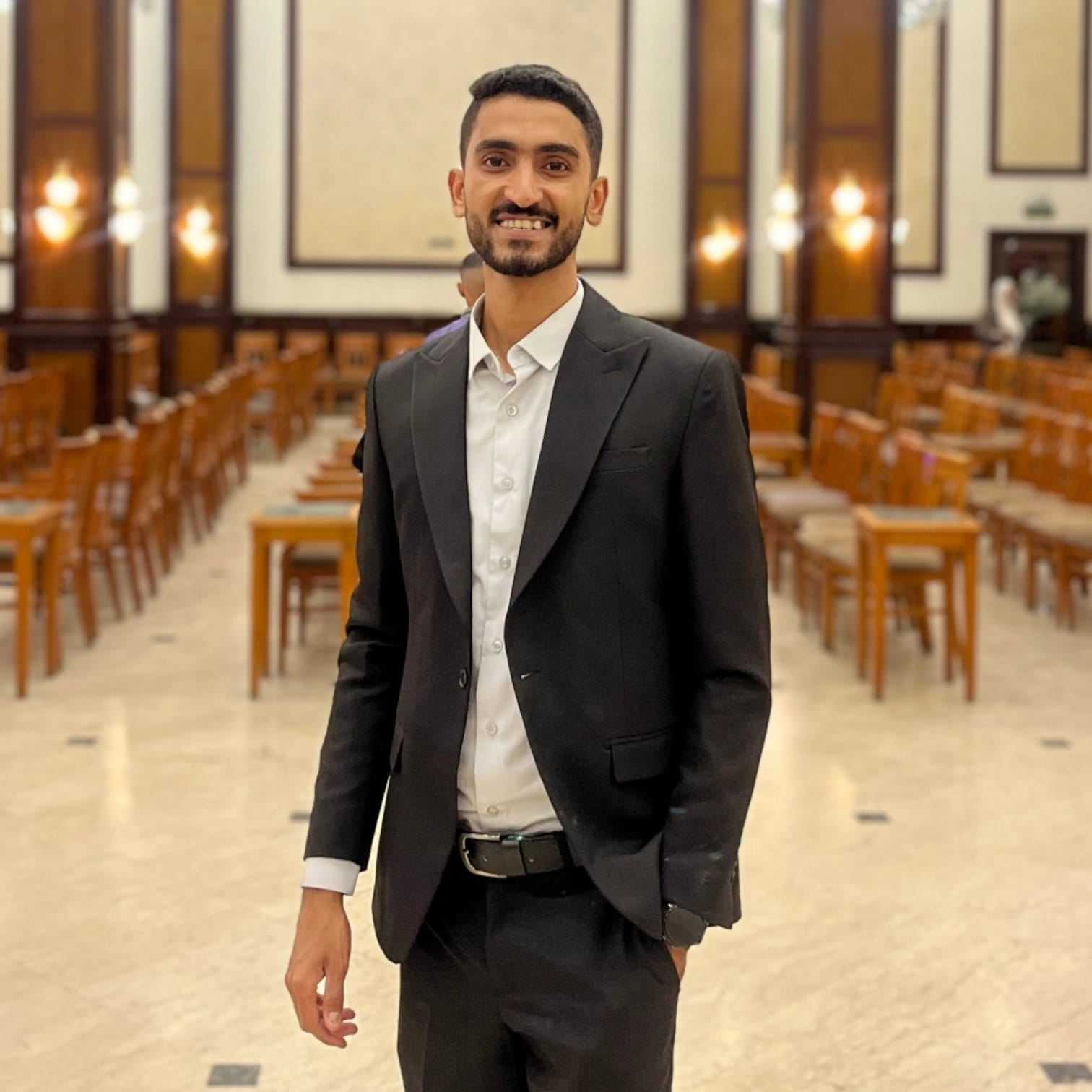
- Based in
- Cairo, Egypt
- Currently
- Full-stack developer at Webeetec
- Works in
- Arabic and English
- Teaching since
- 2022
01Experience
Where the work has happened
Roles and years as they appear on my CV. Client systems built outside these roles are documented in the case studies.
2025 — Present
Employment
Full-Stack Web Developer
WebeetecRemote — Saudi Arabia
Building and maintaining production applications for web- and mobile-facing business products with Laravel, React, Next.js, TypeScript and MySQL.
- Secure REST APIs: authentication flows, authorization policies, validation layers and reusable services.
- Query, caching and API performance work on growing database structures.
- Frontend–API integration and cross-stack production fixes, shipped through Git-based reviews and structured releases.
2022 — 2024
Teaching
Frontend Instructor
ITSharks — MaadiCairo, Egypt
Started as a teaching assistant and progressed to lead instructor, teaching frontend development through practical projects.
- Taught HTML, CSS, JavaScript, React, Tailwind CSS, Git, API integration, component architecture and clean code.
- Mentored students through responsive, portfolio-ready projects, code reviews, debugging and interview preparation.
2023
Internship
Full-Stack Developer Intern
My CompoundCairo, Egypt
Contributed to a real-estate management system built with React, Laravel and MySQL.
- Reusable UI components and API integration.
- Authentication, debugging, database operations and API testing in Postman.
Education
Information Systems
Institute of Information Systems — HICMIS University
Expected 2026
Full-Stack Web Development Diploma
ITSharks
2022
02Core expertise
Seven disciplines, usually in one project
What each discipline means in practice, and where on this site you can see it.
- 01
Full-stack systems
Carrying one system across every layer — schema, business rules, API, admin dashboard and the clients that read from it — so the parts are designed to fit rather than reconciled later.
Stack
- Laravel
- React
- Electron
- MySQL
- 02
Frontend engineering
Typed React and Next.js interfaces: server-rendered pages, bilingual layouts that mirror correctly in right-to-left, and dashboards that stay readable under real data.
Stack
- Next.js
- React
- TypeScript
- Tailwind CSS
- 03
Backend engineering
Laravel back ends that hold the business logic: roles and permissions, inventory and orders, financial calculations, and the reports operators rely on.
Stack
- Laravel
- PHP
- MySQL
- Sanctum
- 04
REST API development
REST APIs shared by web, mobile and desktop clients, with token or session authentication, validated input, and integrations such as online payments, push notifications and WhatsApp messaging.
Stack
- REST
- Laravel Sanctum
- Firebase Cloud Messaging
- Telr
- 05
Software architecture
Deciding the boundaries before the code: tenant isolation in a multi-tenant SaaS, role-based access designed into the data model, and service layers that keep business rules out of controllers and screens.
Stack
- Multi-tenancy
- RBAC
- Prisma
- PostgreSQL
Where it shows
- 06
Mobile development
Flutter and React Native apps built on the same API as the web platform, so customers, staff and administrators work from one source of truth.
Stack
- Flutter
- Dart
- React Native
Where it shows
- 07
Deployment & operations
Getting systems into production and keeping them there: Nginx and PHP-FPM on Linux servers, Docker with PostgreSQL, GitHub Actions workflows, HTTPS, backups and rollback procedures.
Stack
- Nginx
- Linux VPS
- Docker
- GitHub Actions
03Technology
The stack, grouped by the job it does
Each number counts the case studies on this site that name the technology. Tools marked “CV” appear on my CV but are not yet documented in a case study.
Interfaces
- React18 case studies
- TypeScript17 case studies
- Next.js14 case studies
- Tailwind CSS14 case studies
- JavaScript7 case studies
- Vite3 case studies
- Inertia.js2 case studies
- i18next2 case studies
- Redux Toolkit1 case study
Back end
- Laravel15 case studies
- PHP12 case studies
- Laravel Sanctum2 case studies
- Eloquent ORM1 case study
- Prisma1 case study
- Node.js1 case study
- FilamentCV
Data
- MySQL12 case studies
- PostgreSQL1 case study
- SQLite1 case study
Mobile & desktop
- Flutter2 case studies
- Dart2 case studies
- Electron2 case studies
- React Native1 case study
APIs & integrations
- REST APIs21 case studies
- Firebase Cloud Messaging1 case study
- Telr1 case study
- WhatsApp API1 case study
- Google Vertex AI1 case study
- Cloudinary1 case study
- Bunny StreamCV
Delivery & quality
- Linux VPS6 case studies
- Nginx4 case studies
- GitHub Actions3 case studies
- Docker3 case studies
- Git & GitHub2 case studies
- Cloudflare1 case study
- VercelCV
- PHPUnitCV
- PHPStanCV
- PostmanCV
04Teaching & knowledge
Teaching is part of the work, not a side note
From 2022 to 2024 I taught frontend development at ITSharks, starting as a teaching assistant and finishing as lead instructor. Today I write programming guides in Arabic and English and record courses for developers starting out.
Courses
2 tracks are being recorded — not released yet.
Articles
7 guides published in Arabic and English.
Video
Programming content on YouTube and TikTok.
05Working principles
How I hold the work to a standard
A principle is only useful when it changes what gets built. These are the habits behind each one.
Maintainability
Business rules live in services, not in controllers or components, so a change to how the business works is a change in one place.
Security
Authorization is enforced on the server for every action — role policies, tenant scoping and rate limiting, with two-factor authentication and audit logs for administrators where the system calls for them.
Performance
Measure first, then fix: indexed queries, paginated lists, caching for read-heavy endpoints, and images sized for the screen that shows them.
Scalability
Systems are shaped for the growth that is likely — another branch, another tenant, another client app on the same API — without designing for traffic that will never arrive.
Clarity
Explicit API contracts, typed interfaces and written handover documentation, so the next engineer can work without asking what something means.
Accountability
Scope is written down before work starts, known issues are reported rather than hidden, and every deploy has a rollback path.
Testing
Automated tests for the rules that matter, static analysis and formatting checks in the workflow, and API behaviour verified before a client depends on it.
06Elsewhere
Code, career and content
Have a system in mind?
See what I offer and how a project runs from discovery to maintenance — or describe what you need and I’ll reply with questions or a next step.