 Ahmed Alaydi
Zakat – Islamic Financial Platform & Dashboard
A modern Next.js frontend platform for presenting zakat-related content, calculators, FAQs, and dashboard flows with full Arabic support and scalable architecture.
- Role
- Lead Engineer
- Timeline
- Production
- Industry
- Web Frontend
- Status
- Shipped
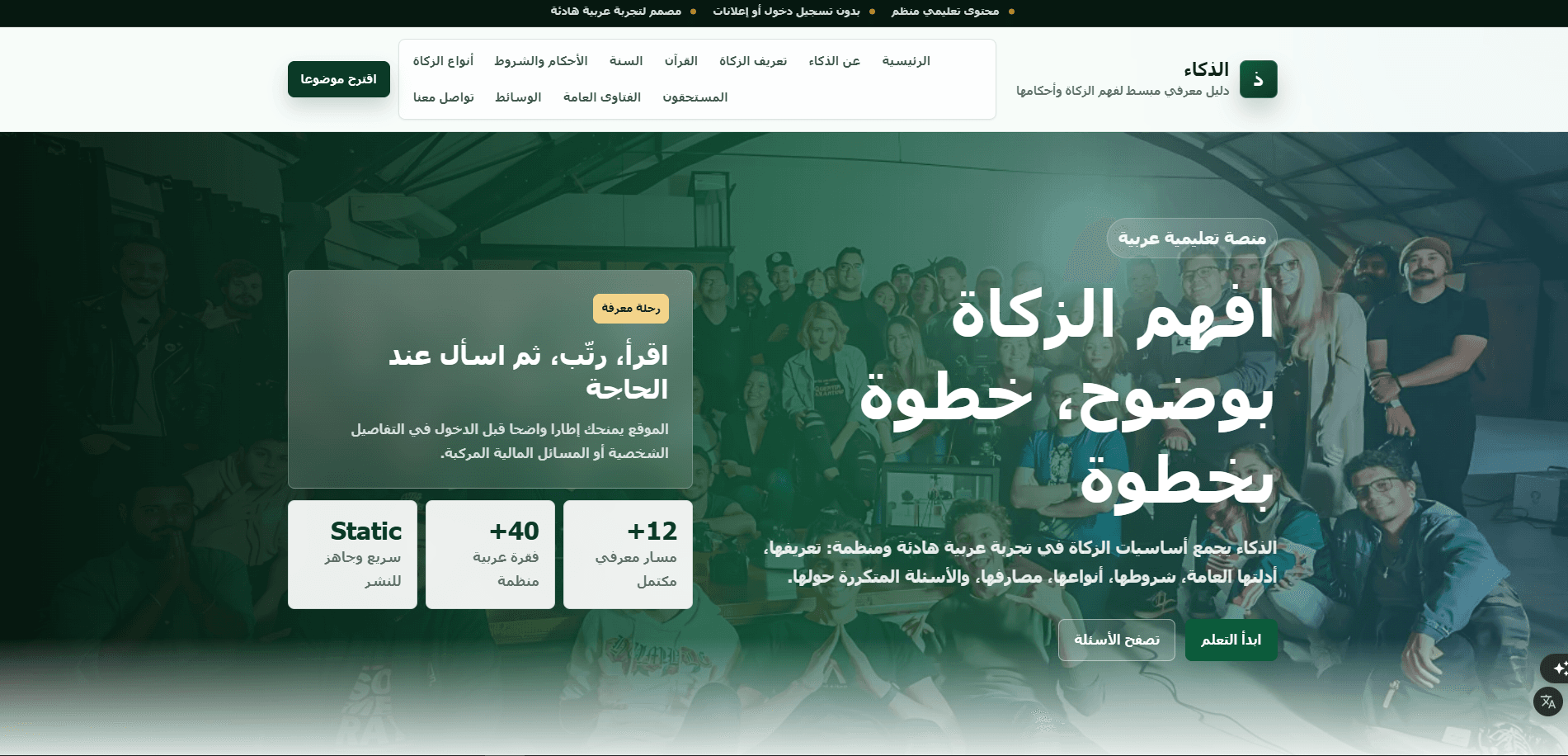
What this system is
Zakat is a frontend web platform built with Next.js to deliver an organized and user-friendly experience around zakat content, educational sections, FAQs, media, and dashboard flows. The project was developed from scratch based on a provided UX structure, with a strong focus on clean component architecture, Arabic RTL support, scalability, and readiness for API integration using Redux.
What we needed to solve
Building a content-rich Islamic platform with multiple sections, dashboard flows, Arabic support, and future API integration requires a clean frontend architecture that can handle scalability, maintainability, and a seamless user experience.
How we shipped it
Developed the full frontend of the platform using Next.js, implementing the provided UX from scratch with reusable components, structured routing, RTL support, dark-ready UI patterns, and Redux-based state preparation for future API integration.
How the system is wired
A modular architecture separating presentation, application, and data layers with REST contracts between the frontend and backend. Designed for clean scaling, observability, and predictable deployments.
Server-rendered + responsive client UI with reusable components and animation primitives.
Business logic in service classes, validated input, role-aware authorisation, and queueable side-effects.
Relational schema with indexed lookups, soft deletes, and migration-backed evolution.
REST APIs, webhooks, and third-party SDKs surfaced through thin adapters.
Engineering choices
In the wild
Hard problems, handled
Building a content-rich Islamic platform with multiple sections, dashboard flows, Arabic support, and future API integration requires a clean frontend architecture that can handle scalability, maintainability, and a seamless user experience.
Developed the full frontend of the platform using Next.js, implementing the provided UX from scratch with reusable components, structured routing, RTL support, dark-ready UI patterns, and Redux-based state preparation for future API integration.
Maintaining performance under realistic production load.
Indexed queries, paginated lists, image optimisation, and lean client bundles kept the platform responsive end-to-end.
Built to stay fast
Design and interaction
Ready to ship and operate
What it does
Why we chose what we chose
Built on Next.js, React.js, TypeScript.
Mature ecosystem, strong typing where applicable, and predictable performance characteristics for the workload.
REST-first integration boundary.
Keeps clients (web, mobile, partner) decoupled and trivially swappable without coupling to a single transport.
Results
Other case studies

Building something similar?
Let's scope your platform — dashboard, mobile apps, APIs, the full stack.